Elite Screens Review 2026: Are These Projection Screens Worth Buying?

What Is Elite Screens?
Elite Screens Inc. is a Foothill Ranch, California-based projection screen manufacturer founded in 2004 by veterans of the AV, IT, and custom installation industries. The company's founding principle was straightforward: cinema-quality projection screens should be accessible to buyers at every budget level, not only to custom installation clients spending tens of thousands of dollars on a dedicated theater room.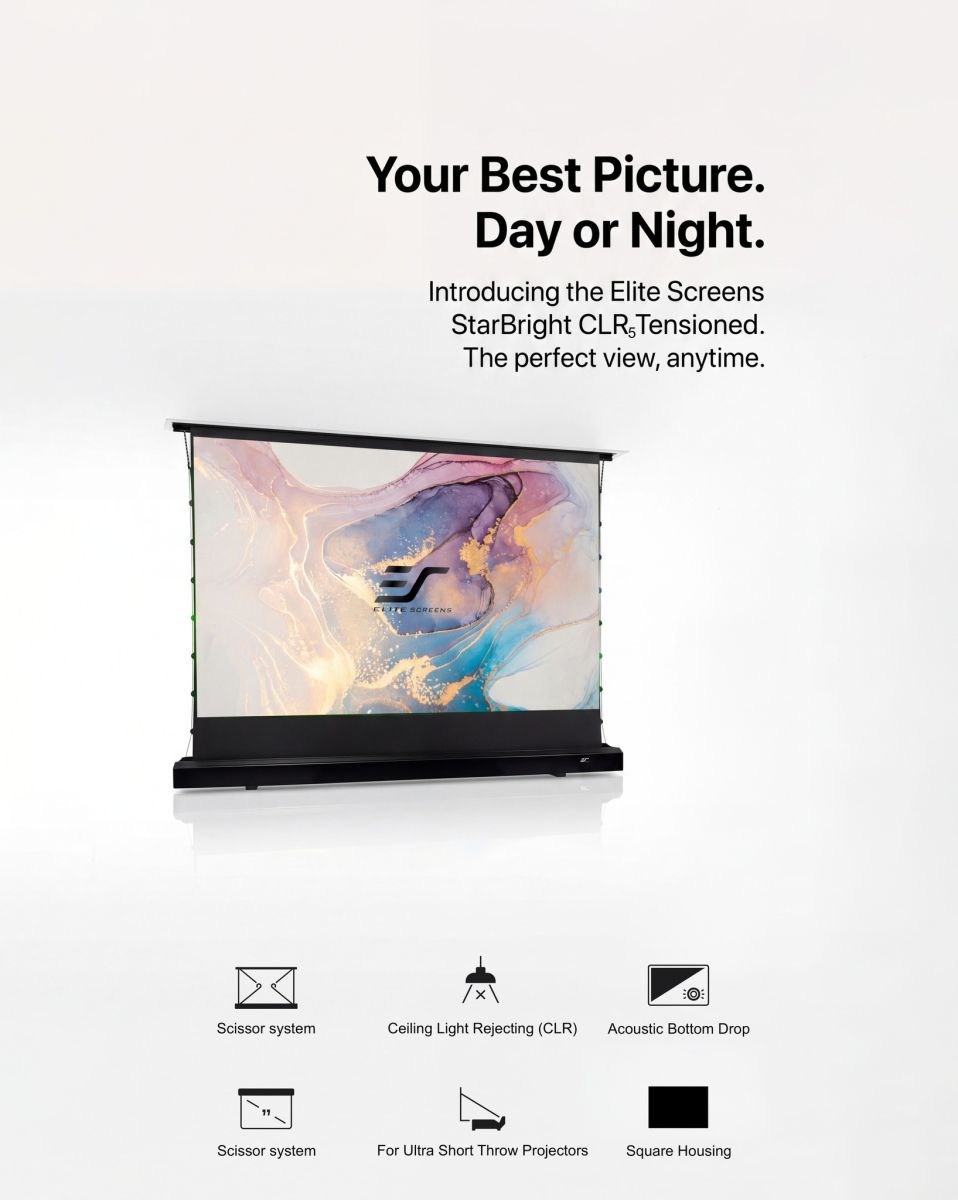
In the two decades since founding, Elite Screens has become one of the most distributed projection screen brands in the world. Their products are sold in over 100 countries through AV retailers, direct-to-consumer online channels, professional installers, and institutional procurement channels. The catalog spans portable tripod screens under $100, manual pull-down screens for home and conference rooms, electric motorized screens for permanent residential and commercial installations, outdoor screens for backyard and event projection, and specialized ALR (ambient light rejecting) screens for rooms where full light control is not possible.
The company holds ISF (Imaging Science Foundation) certification on its screen materials and GREENGUARD and GREENGUARD GOLD UL 2818 certification on select products for indoor emissions safety. For educational institutions, non-profit organizations, religious organizations, and government and military buyers, Elite Screens extends the standard 2-year warranty to 3 years through their ENR-G program.
Key Features: What Makes Elite Screens Different
ISF-Certified Screen Materials
ISF — the Imaging Science Foundation — is the organization that trains and certifies professional AV calibrators worldwide. When they certify a screen material, they are confirming that the surface meets measurable standards for color reproduction accuracy, brightness uniformity, contrast performance, and black-white dynamic range. This matters because a projector can be calibrated to technically perfect color output and still produce a distorted image if the screen surface introduces color shift, gain irregularities, or uneven reflectivity.
The Elite Screens Spectrum motorized series and the Manual SRM Pro premium series both use MaxWhite 2 material with ISF certification — meaning that professional calibrators installing these screens can achieve and maintain calibration-grade color accuracy on the surface. At the price points where Elite Screens operates, ISF-certified surfaces are not standard. Most budget screens use uncertified white materials that look fine to the eye but fail to maintain color accuracy across the viewing angle.
CineGrey 5D: Ambient Light Rejection That Actually Works
The technology that most meaningfully distinguishes Elite Screens from basic projection screen competitors is the CineGrey 5D — a proprietary angular-reflective ALR material that changes the fundamental physics of how the screen surface handles light.
Standard white screen materials scatter light in all directions. Any ambient light in the room — ceiling fixtures, windows, lamps — reflects off a white screen surface the same way the projector's light does, washing out contrast, reducing color saturation, and flattening black levels. To get a quality image on a standard white screen, the room needs to be nearly dark.
The CineGrey 5D addresses this through an angular-reflective surface structure: projected light arriving from the standard throw angle reflects directly back toward the viewer's seating position at the mirror-opposite angle. Ambient light arriving from above, from the sides, and from non-projector directions is absorbed by the contrast layer rather than reflected toward the viewer. The result is a 1.5 gain screen (50% brighter than a 1.0 gain surface) that delivers a sharp, high-contrast image in a room with typical household ambient lighting — a genuinely different result from placing a standard white screen in the same conditions.
One critical technical point: the CineGrey 5D is designed for standard long-throw projectors only. It is not compatible with ultra-short throw (UST) projectors. The angular-reflective mechanism requires light to arrive from a throw distance consistent with standard projector placement. If you are using a UST projector positioned within 60cm of the screen, the CineGrey 5D is not the correct material for your setup.
To help buyers evaluate the material before purchasing a full screen, Elite Screens offers a free CineGrey 5D DIN A4 screen material sample. This is a genuinely useful offer — testing the material in your actual room under your actual lighting conditions before committing to a full screen purchase removes the largest uncertainty from the buying decision.
The Spectrum Motorized Screen: Best-Selling Electric Model
The Spectrum motorized projection screen is Elite Screens' most popular electric screen for residential and light commercial use. The Spectrum deploys and retracts via an infrared remote control, a radio frequency remote (for operation through walls and obstructions), and a wall box controller. It also includes a 12-volt trigger input — the industry standard connection used by AV receivers, projectors, and control systems to automatically deploy the screen when the projector powers on and retract it when the projector powers off. This trigger eliminates the need to remember to deploy the screen separately, and it keeps the screen retracted and protected when not in use.
The MaxWhite 2 surface at 1.1 gain displays a bright, even picture across a wide viewing angle with ISF-certified color accuracy. The Spectrum is compatible with 4K and 8K Ultra HD, Active 3D, and HDR content. For rooms where a permanently visible fixed frame screen is not desirable, the Spectrum's retractable design lets the screen disappear into the ceiling-mounted housing when not in use, restoring the room's standard appearance. Available in multiple sizes across 16:9 and 16:10 aspect ratios.
The Manual SRM Pro: Premium Pull-Down Without Electrical Requirements
For installations where motorized operation is not needed or where running electrical to the screen location is not practical, the Manual SRM Pro premium pull-down screen is Elite Screens' top-tier manual product.
What separates the SRM Pro from budget manual screens is the slow-retract tension mechanism. On cheap pull-down screens, the retraction spring snaps the screen back into the housing quickly and with force, stressing the screen material at the attachment points over time and creating the snap-and-crinkle noise that anyone who has used a classroom projector screen has experienced. The SRM Pro uses a controlled slow-retract system that brings the screen back smoothly at a measured pace, protecting the material and the mechanism. The surface is ISF-certified MaxWhite, compatible with 4K and HDR content, and GREENGUARD certified for indoor air quality compliance. The flush wall mounting bracket system integrates cleanly with wall and ceiling surfaces.
Outdoor and Portable Options
For outdoor movie projection, the Yard Master 2 outdoor screen sets up without tools using a lightweight aluminum frame system, stretches the MaxWhite material taut across the frame, and folds flat for storage and transport. Extension legs for height adjustment are available separately. The outdoor format is designed for the specific challenges of backyard and event projection: weather resistance, tool-free setup and disassembly, and large enough format sizes to serve a group viewing environment.
For portable use without permanent mounting, the Tripod Mobile portable projection screen freestanding on an adjustable tripod base with a keystone eliminator mechanism for precise angle calibration. The four-sided black masking border absorbs projector light overspray, and the adjustable tripod provides stable positioning on varied surface types. The Tripod series is especially well suited for classroom presentations, corporate meetings, church and event use, and any scenario requiring regular setup and takedown without hardware installation.
Accessories and Replacement Parts
A less-discussed but genuinely valuable aspect of buying Elite Screens is the availability of replacement parts and accessories that extend the service life of existing screens. End cap sets for manual series screens, short-distance brackets, extension legs for outdoor screens, and replacement end caps for motorized Spectrum and VMAX2 series screens are all available through the Elite Screens store page. For most common screen failure modes — cracked end caps, bent frame components, worn retraction mechanisms — a parts purchase is significantly cheaper than replacing the full unit, and Elite Screens stocks them specifically because they understand that buyers want their screens to last.
Who Is Elite Screens For?
Home theater enthusiasts building their first or second dedicated theater space who want ISF-certified screen surfaces and genuine construction quality without the $800 to $3,000 price premium of Da-Lite, Draper, or Stewart Filmscreen installations. Elite Screens occupies a specific and valuable market position between the commodity screens sold at mass retailers and the professional-grade screens specified by high-end custom installers. For most residential buyers, this middle position delivers more than enough performance at a fraction of the price.
Rooms with ambient light challenges are a particularly strong use case for Elite Screens given the CineGrey 5D material availability. Living rooms, bedrooms, and open-plan spaces where full light control is not practical represent the most common real-world projection scenario, and CineGrey 5D addresses it more effectively than standard white screens at any price.
Corporate, educational, and institutional buyers benefit from the ISF-certified surfaces for calibrated presentations and the ENR-G 3-year warranty extension available to educational, non-profit, religious, and government organizations. The Tripod portable series is a proven classroom and conference room standard.
Event and outdoor users who want quality projected image quality beyond the inflatable screen category will find the Yard Master 2 series a practical and well-priced alternative to custom outdoor projection setups.
Pricing: What to Expect
Elite Screens products range from approximately $60 to $100 for portable tripod models to $300 to $600 for quality motorized Spectrum screens in standard diagonal sizes. Manual SRM Pro screens typically fall in the $150 to $400 range depending on size. The CineGrey 5D material commands a premium over standard white surfaces of approximately 20 to 40 percent within the same screen format.
For context: a Da-Lite Contour Tensioned electric screen in a comparable size runs $600 to $1,200. A Stewart Filmscreen electric at similar specifications runs $1,200 to $3,000 and up. Draper's commercial electric screens run $500 to $1,500 for residential-appropriate sizes. Elite Screens at $300 to $600 for a motorized screen with ISF-certified surface represents a significant cost saving for buyers who have done their research and concluded that ISF certification and reliable construction are the meaningful metrics, not the brand name on the housing.
The AVS Forum community's consensus captures this well: one veteran home theater builder described Elite Screens as "a really good product for the budget conscious buyer" after sampling screen materials from Da-Lite, Carada, and Stewart and concluding that none performed meaningfully better for their use case than Elite's material at a fraction of the price.
Find all current Elite Screens deals and verified discount codes at Greats Coupons Elite Screens page.
Pros and Cons
Pros
The ISF certification on Elite Screens surfaces is a meaningful credential that most screens at this price point do not carry. It confirms color accuracy performance that matters for anyone pairing the screen with a calibrated projector setup.
The CineGrey 5D ambient light rejection technology genuinely changes what is possible in a room that cannot be fully darkened. In a typical living room with normal lighting, the difference between a standard white screen and a CineGrey 5D screen at the same projector output is visible and substantial.
The slow-retract mechanism on the SRM Pro manual screen addresses the primary quality-of-life failure of budget manual screens — the snapping retraction that stresses the material and creates noise with every use.
The Spectrum's 12-volt trigger integration enables fully automated deployment with the projector, removing the manual step from every viewing session and ensuring the screen stays protected when not in use.
The free CineGrey 5D DIN A4 sample is a genuine customer service advantage for buyers evaluating whether ALR material is worth the premium for their specific room conditions.
The availability of accessories and replacement parts for existing screens reduces long-term cost of ownership significantly compared to brands that do not stock replacement components.
Cons
The CineGrey 5D material is incompatible with ultra-short throw projectors, which limits its applicability for the growing UST projector market. Buyers with UST projectors need to evaluate Elite Screens' CLR series instead.
Some AVS Forum community members have noted screen uniformity inconsistencies in certain product batches, particularly on older purchases. While Elite Screens addresses warranty claims, the experience of receiving a replacement with the same uniformity issue has been reported by a minority of buyers.
The warranty claims process requires the buyer to ship the defective screen to Elite Screens, which can be logistically challenging for large screen sizes. For a 135-inch fixed frame screen, shipping it back for a warranty claim involves non-trivial packaging and freight cost.
Elite Screens vs. The Competition
Elite Screens vs. Da-Lite: Da-Lite is a heritage commercial and professional AV screen brand with a stronger institutional reputation and a broader custom configuration program. For professional AV integrators specifying screens in commercial installations, Da-Lite offers deeper customization, broader dealer support, and a stronger professional network. For residential buyers comparing on price-to-performance, Elite Screens delivers comparable surface quality at 40 to 60 percent less cost. The AVS Forum consensus is that Elite Screens is a strong value alternative to Da-Lite for residential applications where the professional installation support network is not a purchasing factor.
Elite Screens vs. Stewart Filmscreen: Stewart Filmscreen is the benchmark for premium projection screens in dedicated home theater installations. In professional blind comparisons, Stewart's Studiotek and Cima materials do outperform Elite Screens surfaces in calibrated, fully light-controlled environments — demonstrating slightly better color rendering, micro-uniformity, and black level performance. The relevant question is whether the difference is worth 5 to 10 times the price. For a $20,000 home theater installation where every component is optimized, the answer may be yes. For a $2,000 to $5,000 setup, the Elite Screens surface delivers performance that is not meaningfully inferior in everyday viewing conditions.
Elite Screens vs. Draper: Draper occupies a similar market position to Da-Lite — strong in commercial AV, educational, and professional installation channels, priced above Elite Screens, with a comparable quality level at that price. For buyers who need commercial-grade construction and professional dealer support, Draper is a strong choice. For DIY residential buyers who do not require commercial-grade specification support, Elite Screens offers better value.
Final Verdict: Is Elite Screens Worth It in 2026?
For buyers seeking quality projection screens at accessible prices, Elite Screens delivers one of the most credible value propositions in the market in 2026.
The ISF certification on their screen surfaces is not a marketing claim — it is a third-party validation from the organization that trains professional calibrators. The CineGrey 5D ALR material addresses the single biggest real-world problem in home projection: ambient light degrading image quality in rooms that cannot be fully darkened. The Spectrum motorized series delivers automated deployment functionality, professional surface quality, and 4K/8K compatibility at pricing that is $300 to $1,500 less than comparable Da-Lite and Stewart Filmscreen configurations.
The honest limitation is that Elite Screens operates between two market tiers: above commodity screens in quality and below true professional-grade screens in construction precision and material refinement. For the buyers who fall into that middle segment — which is the vast majority of home theater enthusiasts — the quality-to-price ratio is compelling and well-validated by the community.
One practical note before buying: if you are considering a CineGrey 5D screen, order the free material sample first. Testing ALR performance in your specific room under your specific lighting conditions is the only way to know with certainty whether the upgrade is worthwhile for your setup, and Elite Screens makes that evaluation free.
Rating: 4.5 / 5
Frequently Asked Questions
Q: Are Elite Screens good quality?
A: Yes. Elite Screens uses ISF-certified screen materials on their main product lines — a third-party quality validation from the Imaging Science Foundation that confirms color accuracy, brightness uniformity, and contrast performance. Their Spectrum motorized and SRM Pro manual series deliver professional-grade surface quality at pricing significantly below Da-Lite, Draper, and Stewart Filmscreen. The AVS Forum home theater community and Dreamedia AV consistently rate Elite Screens as the best value at their price tier for residential installation.
Q: What is the difference between a Spectrum and an SRM Pro screen?
A: The Spectrum is an electric motorized screen — it deploys and retracts automatically via a remote control or 12-volt trigger from a connected projector or AV receiver. The SRM Pro is a premium manual pull-down screen requiring no electrical installation, deploying by hand and retracting via a controlled slow-retract mechanism. Both use ISF-certified MaxWhite 2 material. Choose the Spectrum if you want automated operation. Choose the SRM Pro if you want high-quality manual operation with no electrical work required.
Q: Is the CineGrey 5D compatible with ultra-short throw projectors?
A: No. The CineGrey 5D is designed exclusively for standard long-throw projectors and will not produce a correct image with ultra-short throw projectors. UST projectors project from a very steep, close angle that the angular-reflective CineGrey 5D material reflects upward rather than toward the viewer. For UST projectors, Elite Screens' CLR (Ceiling Light Rejecting) material series is the appropriate choice.
Q: Can I try the CineGrey 5D material before purchasing a full screen?
A: Yes. Elite Screens offers a free CineGrey 5D DIN A4 screen material sample. The sample is available through the Elite Screens deals page at Greats Coupons and allows you to test the material's ambient light rejection performance in your actual room before committing to a full screen purchase.
Q: What warranty does Elite Screens offer?
A: Elite Screens provides a standard 2-year manufacturer warranty on all products. For purchases made by Educational institutions, Non-profit organizations, Religious organizations, and Government or Military organizations, the warranty extends to 3 years through the ENR-G program. Warranty claims require the buyer to ship the defective product to Elite Screens; contact their support team to initiate a claim and receive an RMA number.
Q: How does Elite Screens compare to Da-Lite in price?
A: Elite Screens motorized screens in standard residential sizes typically cost $200 to $600. Comparable Da-Lite motorized configurations run $600 to $1,200. The surface quality difference between the two brands at this price range is measurable in professional calibration environments but not meaningfully perceptible in typical residential viewing conditions. For buyers who do not require professional installer specification support or commercial-grade custom configurations, Elite Screens delivers comparable image quality at 40 to 60 percent less cost.
Q: Where can I find the latest Elite Screens discounts?
A: The latest Elite Screens deals, coupon codes, and verified discounts are available at greatscoupons.com/store/elite-screens. All links on that page go directly to the Elite Screens store with affiliate tracking and current promotional pricing applied.
Ready to shop Elite Screens?
See All Elite Screens Deals and Coupon Codes at Greats Coupons
ISF-certified screen surfaces. CineGrey 5D ambient light rejection. 2-year manufacturer warranty. Trusted in 100+ countries.
Popular Blog





.jpg)