Clicks Technology Review 2026: The Physical Keyboard iPhone Case That Sold 100,000 Units and Is Now Building a Smartphone

What Is Clicks Technology?
Clicks Technology Ltd is a London-headquartered smartphone accessories company founded by Michael Fisher, the YouTube tech reviewer known as MrMobile with 1.2 million subscribers, and Kevin Michaluk, who built the CrackBerry community into the definitive destination for Blackberry users before that platform's decline. Both founders came from the mobile technology world with a personal and professional history with physical keyboards, and both had spent years watching the touchscreen paradigm make typed communication on smartphones slower, less accurate and more frustrating than it needed to be.
The company's affiliate program summarizes the product positioning precisely: "After going viral in 2024 with 500 million earned media impressions, Clicks sold out worldwide. Clicks customers range from artists and best-selling authors to CEOs and students." That customer range reflects the breadth of the use case. Anyone who types a lot on their phone and finds touchscreen typing a bottleneck is the target audience.
The Clicks Product Lineup in 2026
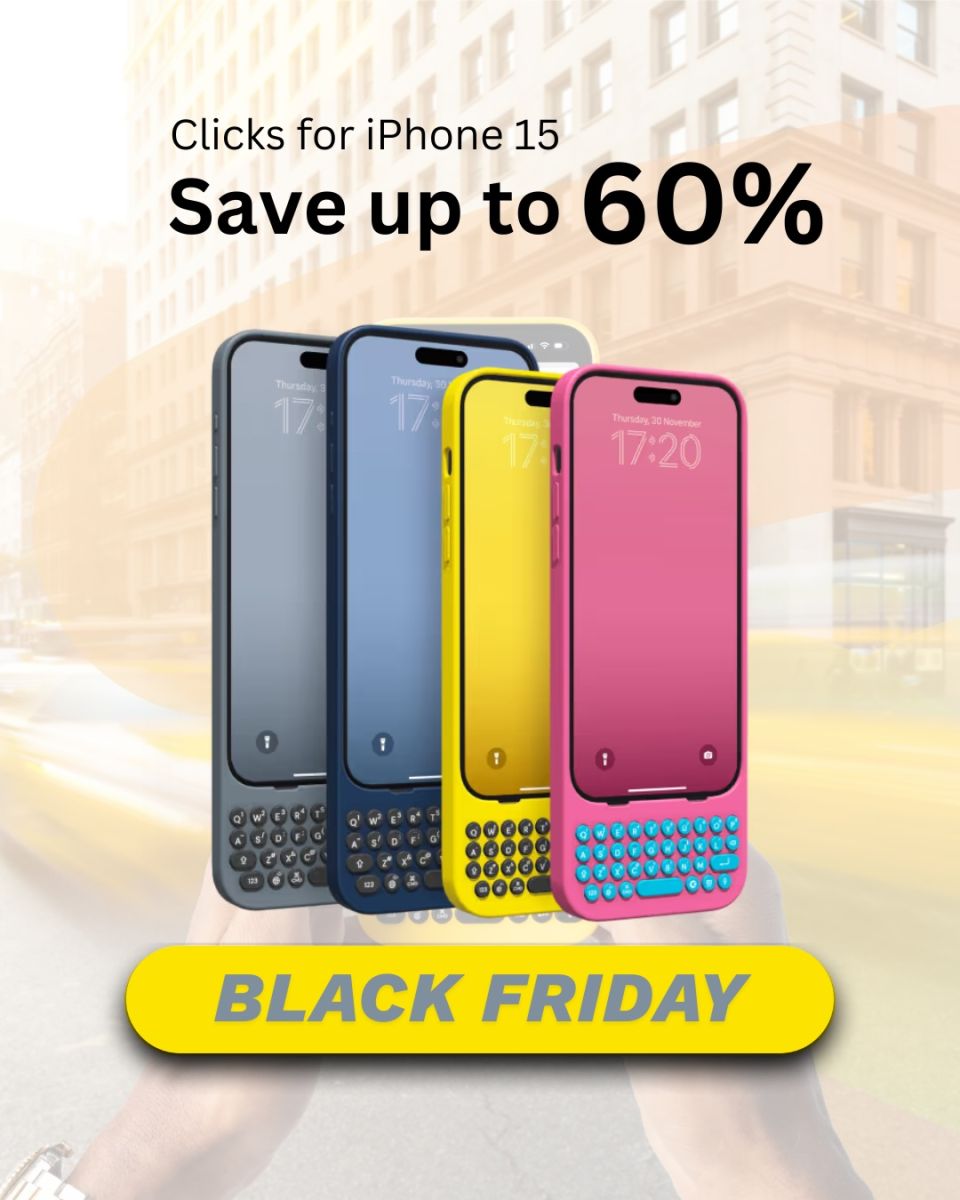
Clicks Keyboard Cases for iPhone
The core product line remains the iPhone keyboard case. Clicks attaches to the bottom of the iPhone, adding a full four-row backlit QWERTY keyboard below the display. The virtual keyboard disappears when Clicks is connected, freeing 50 percent of the display that was previously consumed by the on-screen keys during any typing activity.
The Clicks Keyboard for iPhone 17 is the current flagship. The iPhone 17 version is 40 percent thinner on the sides and meaningfully lighter than the iPhone 16 Pro generation, with MagSafe built in and a faster snap-in attachment mechanism. The iPhone 17 version has accumulated 5,328 user reviews since launch. One reviewer, identifying as a former Blackberry convert, wrote: "As a Blackberry lover with a long term investment in iPhone apps, this is the best combination of form and efficiency. If you have never tried this accessory, try it. The keyboard is legendary."
The Clicks Keyboard for iPhone 16 added MagSafe compatibility to the Clicks case for the first time, resolving the primary criticism of the iPhone 15 version. Wireless chargers, car mounts and magnetic accessories now work through the case without removal. USB-C data transfer, pass-through charging and wired CarPlay support are all available through the iPhone 16 case. Brushed metal side keys and a microfibre lining elevate the premium feel of the enclosure.
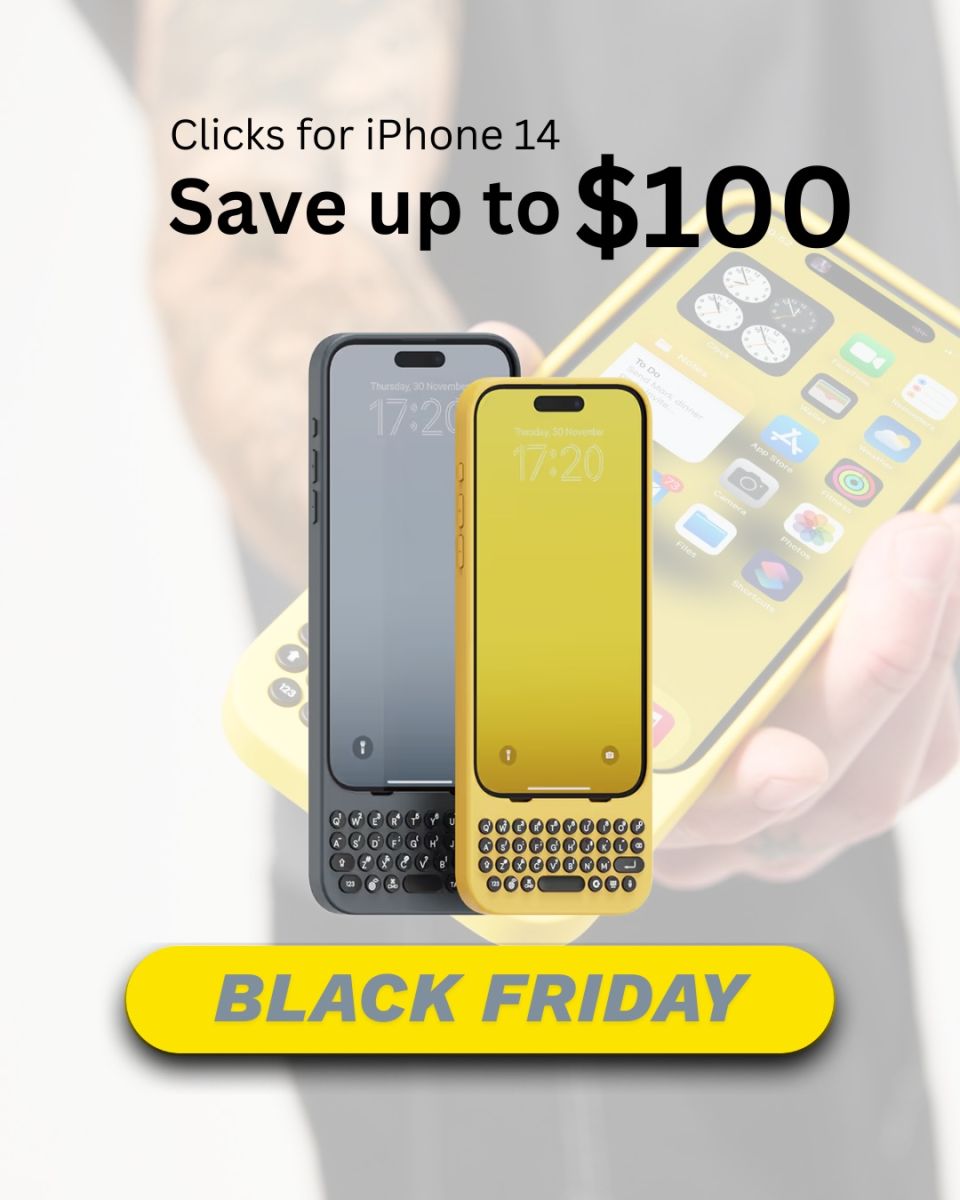
The Clicks Keyboard for iPhone 15 is the generation that established Clicks as a serious product category rather than a launch novelty, and remains an excellent option for iPhone 15 users. The Clicks Keyboard for iPhone 14 extends the same experience to the previous generation.
For Android users, the Clicks Keyboard for Google Pixel brings physical keyboard typing to the Pixel lineup. The Clicks Keyboard for Motorola Razr 2025 and Clicks Keyboard for Motorola Razr 2024 are purpose-built for the Razr's distinctive flip-phone form factor.
The Certified Open Box Clicks Keyboard is available at up to 30 percent off new pricing, tested and certified by Clicks to perform to new product standards.
The Clicks Power Keyboard (CES 2026)
At CES 2026, Clicks unveiled the Power Keyboard: a MagSafe keyboard accessory that attaches magnetically to the back of any MagSafe or Qi2-compatible iPhone or Android device. Unlike the case-format keyboards, the Power Keyboard connects over Bluetooth 5.4, making it compatible with virtually any modern smartphone, tablet, smart TV, or VR headset. It contains a 2,150 mAh battery that provides wireless charging at 5W while the keyboard is in use. It supports simultaneous connection to three devices with easy switching between them. The keyboard slides out from behind the phone for use and retracts when not needed. Pre-order pricing was $80; retail will be $110.
The Clicks Communicator Smartphone (CES 2026)
The most significant development in the Clicks story in 2026 is not a keyboard case but a phone. The Clicks Communicator, announced at CES 2026, is a compact Android 16 smartphone with a built-in physical QWERTY keyboard, a 4.03-inch AMOLED display at 1080x1200 resolution, a 50MP rear camera with optical image stabilization, a 24MP front-facing camera, 256GB of storage, hardware encryption, a headphone jack, and Qi2 wireless charging. Priced at $499 with earlier pre-order pricing at $399, it ships Q4 2026.
Cybernews describes it as "communication-centric, focused, and differentiated from do-everything smartphones." Clicks' own framing positions it as a companion to a primary iPhone or Android device, not a replacement. The custom Android 16 launcher prioritizes messaging applications including Telegram, WhatsApp, Slack and Gmail, and is explicitly designed to reduce social media access. The company's tagline for it is: "for doing, not doomscrolling."
 Who Is Clicks Technology For?
The honest answer is not everyone. Clicks works for a specific profile of iPhone or Android user, and the product is better understood by being precise about who that is.
People who type a lot on their phone for professional or creative purposes are the core Clicks customer. The product has a consistent following among journalists, writers, lawyers, and executives who write long emails and messages on their phones and find the touchscreen keyboard a meaningful bottleneck. The screen space recovered from eliminating the on-screen keyboard is not a marginal benefit for these users; it is a fundamental change in how much they can see while they are typing.
Former Blackberry users represent a large and enthusiastic segment of the Clicks customer base. The physical keyboard muscle memory that Blackberry users developed over years was abandoned when Blackberry collapsed as a platform, and many of them have never been fully satisfied with touchscreen typing as a replacement. Clicks speaks directly to this audience and the product does what they remember physical keyboards doing.
Heavy mobile content creators who produce written content primarily on their phones benefit from the screen space and typing speed improvements. Michael Fisher himself uses the product for this reason.
The product is less well suited to users who primarily consume content on their phones rather than produce it, users who prioritize minimal phone bulk over productivity features, and users whose most typing-intensive activity is casual text messaging rather than longer-form professional communication.
Clicks vs. The Alternatives: A Complete Comparison
 Clicks vs. Touchscreen Typing with a Third-Party Keyboard App
The most common alternative to Clicks is simply using a better software keyboard app. SwiftKey, Gboard, and Fleksy all offer improvements over the native iOS keyboard, including swipe typing, better autocorrect, and predictive text.
The fundamental limitation of software keyboard alternatives is that they do not recover screen space. A better software keyboard still occupies the bottom half of the display while you are typing. The tactile feedback is still absent. The typing accuracy improvements from physical keys, where your fingers know where the keys are by feel rather than by looking at a screen, are not available from any software solution.
For light typists who are satisfied with touchscreen typing speed and accuracy, a keyboard app is a free alternative that costs nothing. For heavy typists who have noticed that the on-screen keyboard is a speed and accuracy bottleneck, no software keyboard resolves the underlying physical constraint.
Clicks vs. Bluetooth Keyboard Phone Stands and Portable Keyboards
Portable Bluetooth keyboards paired with a phone stand represent another alternative: a physical keyboard that works with the phone but does not attach to it. Logitech's Keys-2-Go 2 retails for $79.99 without backlighting and requires separate pairing for each device.
The advantage of a Bluetooth keyboard is device universality; one keyboard works with any phone, tablet, or computer. The disadvantage is the two-piece setup: the phone needs to be propped in a stand, and the keyboard is a separate object to carry. For users who are stationary at a desk or table, this arrangement is functional. For mobile use on the go, a two-piece arrangement is impractical in contexts where Clicks can be used single-handed.
The Clicks Power Keyboard (announced at CES 2026) actually closes this gap by connecting over Bluetooth and attaching magnetically to the phone, making it a hybrid between the case format and a standalone Bluetooth keyboard. It works with any MagSafe or Qi2-compatible device and includes a built-in battery charger.
Clicks vs. Unihertz Titan and Other Physical Keyboard Android Phones
Physical keyboard Android phones still exist in small numbers. The Unihertz Titan series has maintained a dedicated following for buyers who want a physical keyboard on a smartphone without a separate accessory. The Unihertz Titan Slim runs approximately $300 to $400 depending on configuration.
 The limitation of Unihertz and similar physical keyboard Android phones is the operating system ecosystem. For committed iPhone users, switching to an Android device to get a physical keyboard means losing iMessage, FaceTime, Apple Watch connectivity, AirDrop, and the App Store catalog. For Google Pixel users, the Clicks for Google Pixel keyboard case provides physical keyboard typing on the Pixel ecosystem without the compromise of switching devices.
The Clicks Communicator at $499 ($399 early pre-order) actually competes more directly with physical keyboard Android phones like Unihertz, positioned as a companion messaging device rather than a primary phone. For buyers who want a full physical keyboard phone rather than a case attachment, the Communicator is worth watching for Q4 2026 availability.
Clicks vs. the Blackberry (for Nostalgia Buyers)
Blackberry as a platform is dead. The last Blackberry-branded physical keyboard Android phone, the Key2, was discontinued in 2019. Remaining Key2 and Key2 LE units are available as used or refurbished through third-party sellers at prices ranging from $100 to $250, running Android 8.1 with no official software support.
Buying a used Blackberry in 2026 means accepting a phone with no security updates, no compatibility with modern apps that have dropped API support for Android 8.1, no 5G, and no path to software improvement. The physical keyboard experience is as good as it ever was, but the platform surrounding it has been abandoned.
Clicks provides the tactile keyboard experience of the Blackberry era on a current iPhone or Android device with full iOS or Android platform support, current app compatibility, 5G, and continued software development. For buyers who have been holding onto a Blackberry out of keyboard preference, the Clicks keyboard case is the practical path to modern smartphone capability without giving up physical keyboard typing.
Clicks vs. Work Louder Creator Micro (For Productivity Keyboard Shortcut Users)
Some buyers interested in Clicks are primarily interested not in the typing experience but in the programmable shortcut key functionality: the ability to launch applications, execute iOS shortcuts, and control smart home devices with single key presses. This use case overlaps with the audience for dedicated macro pads.
Work Louder makes premium programmable macro pads including the Creator Micro, WRK Icon and Nomad-E for creators, developers and power users who want customizable shortcut keys for desktop and laptop workflows. Work Louder products are desktop and laptop peripherals rather than smartphone accessories, and they operate with open-source QMK firmware for deep programmability. For the specific use case of desktop workflow automation with a dedicated macro pad, Work Louder is a more purpose-built solution. For mobile productivity shortcut execution on an iPhone, Clicks PowerKeys provides the same functionality in a mobile-native format.
Clicks for iPhone 17: Feature Breakdown
For buyers considering the current-generation Clicks keyboard, here is what the iPhone 17 version includes:
Physical keyboard: four-row QWERTY layout with raised, contoured key caps. Backlit with adjustable brightness through the Clicks App. The key feel has been refined over four generations and is described by multiple reviewers as satisfying and accurate.
Screen space: 50 percent more usable display when the on-screen keyboard is replaced by the physical keyboard. This improvement applies to every typing context: email, messages, documents, code, notes and any other keyboard-intensive application.
Case protection: the Clicks enclosure provides drop protection equivalent to a standard protective case, with brushed metal side keys and a microfibre lining on the iPhone 17 version.
MagSafe: built-in MagSafe compatibility allows wireless chargers, car mounts and magnetic accessories to work through the case without removal.
Clicks App: manages backlight settings, configures the 36 programmable action buttons, and receives firmware updates that add new features. Shortcut programming allows direct launch of specific applications, iOS shortcuts, contacts and smart home controls from single key presses.
Connectivity: wired connection through the iPhone's USB-C port. Zero latency. No Bluetooth pairing required. No separate battery to charge in the keyboard itself.
Warranty and returns: 30-day no-questions-asked returns. 1-year defect replacement warranty. Next-day shipping on in-stock models purchased at clicks.tech.
Pricing: the iPhone 17 Clicks keyboard launches at clicks.tech exclusively for Batch 1, with potential availability at Amazon and Best Buy in 2026. Check Greats Coupons for the latest pricing and any available discount codes.
Honest Assessment: What Clicks Gets Right and Where It Falls Short
What Clicks gets right is the core premise. Recovering 50 percent of the display during typing is a meaningful, measurable improvement for heavy typists. The tactile key feedback accelerates learning and improves accuracy over the touchscreen keyboard for most users who give it sufficient time. The programmable shortcut keys genuinely extend what is possible from the phone without opening a laptop. The 30-day return policy removes the purchase risk for buyers who are uncertain whether the product will suit their workflow.
Where Clicks falls short is more individual than universal. The added weight is real and reviewers with Pro Max models notice it more than those with standard models. The device-specific design has been the primary criticism since launch; buying a Clicks keyboard for iPhone 16 means it does not fit iPhone 17 and requires a new purchase on upgrade. The Power Keyboard announced at CES 2026 addresses this with MagSafe and Bluetooth compatibility, but the Power Keyboard is a different product format with different tradeoffs.
The learning curve is genuine. Tom's Guide's reviewer noted the adjustment period before returning to a comfortable typing rate. For buyers who try Clicks for a week and do not find it clicking, the 30-day return window needs to be used deliberately rather than passively.
Final Verdict
Clicks Technology in 2026 is no longer a single-product novelty. It is a company that has shipped over 100,000 keyboard cases, expanded to Android platforms, launched a MagSafe universal keyboard battery, and unveiled a standalone smartphone with a physical keyboard at CES 2026. The four generations of keyboard cases have refined the product meaningfully with each release. The iPhone 17 version, with its thinner profile, built-in MagSafe and faster attachment mechanism, is the most compelling version yet.
For heavy mobile typists, Blackberry converts, and productivity-focused iPhone users who have noticed that the on-screen keyboard is slowing them down, Clicks is the best-validated solution in the market. The 5,328 user reviews, the 100,000 units shipped, and the Tom's Guide coverage collectively represent more validation than almost any iPhone accessory reaches.
For buyers who are primarily consumers rather than creators on their phones, or who prioritize minimal device bulk, Clicks is a capable product solving a problem they do not have.
Rating: 4.5 / 5
Frequently Asked Questions
Q: Is the Clicks keyboard worth buying in 2026?
A: For heavy mobile typists, yes. The combination of 50 percent more screen space during typing, physical key tactile feedback, 36 programmable shortcuts, and built-in MagSafe on the iPhone 16 and 17 versions makes Clicks the most complete physical keyboard solution available for iPhone. The 100,000 units shipped and 5,328 user review base validate the core product promise at a scale that novelty products do not reach.
Q: Which Clicks keyboard model should I buy?
A: Buy the model that matches your current iPhone or Android device. Clicks for iPhone 17 (for iPhone 17 and 17 Pro), Clicks for iPhone 16 (for iPhone 16 and 16 Plus), Clicks for iPhone 15, Clicks for iPhone 14, Clicks for Google Pixel, and Clicks for Motorola Razr 2024/2025 are all current and available. The Certified Open Box option saves up to 30 percent if budget is a consideration.
Q: Does the Clicks keyboard work with MagSafe?
A: Yes on iPhone 16 and iPhone 17 versions. The iPhone 16 was the first Clicks keyboard to include built-in MagSafe, and the iPhone 17 version continued this. Earlier versions for iPhone 15 and 14 do not have built-in MagSafe, though some users added aftermarket magnetic rings to their cases as a workaround.
Q: How does Clicks compare to just using a Bluetooth keyboard with a phone stand?
A: Clicks is more mobile and more integrated. A Bluetooth keyboard requires a two-piece setup: phone propped in a stand, keyboard as a separate object. This works at a desk but is impractical for mobile use. Clicks attaches to the phone and is used as a single unit. The wired connection also means zero input latency compared to Bluetooth. The Clicks Power Keyboard announced at CES 2026 bridges this gap with MagSafe attachment and Bluetooth connectivity.
Q: What is the Clicks Communicator?
A: The Clicks Communicator is a standalone Android 16 smartphone with a built-in physical QWERTY keyboard, announced at CES 2026 and shipping Q4 2026. It features a 4.03-inch AMOLED display, a 50MP rear camera, 256GB storage, hardware encryption, a headphone jack, and Qi2 wireless charging. Priced at $499, it is positioned as a companion messaging device rather than a primary phone replacement. Pre-order pricing was $399.
Q: Where can I find Clicks Technology discount codes?
A: The latest verified Clicks Technology deals and promo codes are at greatscoupons.com/store/clicks-technology. The Certified Open Box option available there provides up to 30 percent off new keyboard pricing on tested and certified units.
Ready to try Clicks Technology?
See All Clicks Technology Deals and Coupon Codes at Greats Coupons
Physical QWERTY keyboard for iPhone 17, 16, 15, 14, Google Pixel and Motorola Razr. 50% more screen space. MagSafe compatible. 5,328 user reviews. Free US shipping. 30-day returns.
Popular Blog




.jpg)